
Psychologist JoVo
Research ADHD/ADD in adults
Our centre of expertise has specialised in research into ADD and ADHD in adults for many years. You can make an appointment yourself below in the diary of Jan Schrans, clinical psychologist with 36 years of research experience. This research can be done in Kruisem or via video call. As testing yields little in adults with ADHD, we conduct a clinical examination that is quick (one appointment in slightly over two hours and a questionnaire) and affordable (350 euros, all-inclusive, and 500 euros in English). You will receive an official certificate (recognised in the EU) with a detailed report within a week. Furthermore, you will also receive our treatment package along with the report.
There is currently a two-month waiting list.
Scientific research is increasingly demonstrating a link between female hormones and ADHD. Our Centre closely monitors the state of this research regarding women and ADHD.
AD(H)D research
Short waiting time, correct diagnosis, healthy treatment programme included.
Make your own appointment
Make your own online appointment for the ADD/ADHD examination in our diary here. You will be taken directly to Jan Schrans who will do the full examination.
What is AD(H)D?
Read here quickly and clearly what ADHD is and the difference between ADD and ADHD, for example.
Treatment Programme
Discover our healthy, safe online tailor-made treatment programme.

Our centre of expertise for ADHD and ADD
We perform diagnostic testing for AD(H)D in adults throughout Flanders and the Netherlands. The research takes just over two hours, including via video call. We deliver a correct examination without a long waiting list and you get (in case of an examination here) our treatment programme at, free of charge. You will get straight to the psychologist you choose in our online calendar.
Jan Schrans | Clinical psychologist

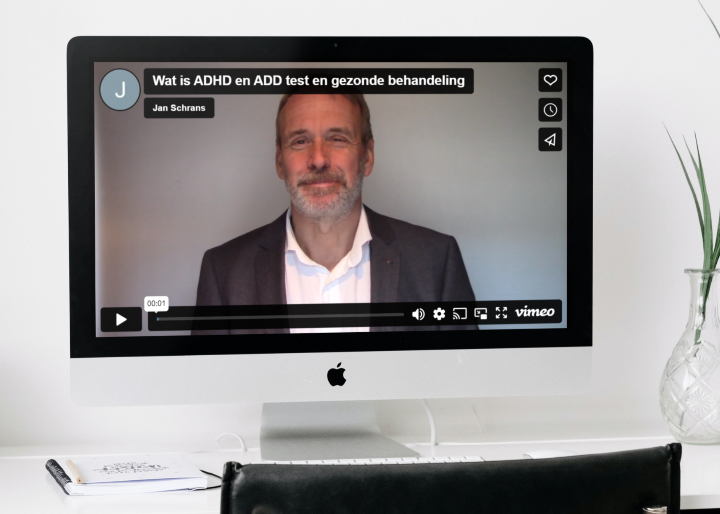
Research ADD in adults at Psychologist JoVo Psychologist Practice
During our examination of ADHD/ADD, you will be clinically questioned In our ADHD/ADD expertise centre. We will provide you with a report of it within a week, including treatment advice . Afterwards, you can get free support by e-mail.
Frequently asked questions
We understand that you may be left with many unanswered questions. In addition to our free webinar On our website you will find a lot of information on ADHD/ADD. Would you like an examination? Then make an appointment in our agenda.
What to expect from the survey?
Determining ADHD/ADD requires a careful research. You may well suspect that you have ADD or ADHD symptoms based on what you read or heard. But ADHD/ADD test examination of concentration problems should be done carefully with a clinical psychologist, neurologist or psychiatrist.
Our centre of expertise combines our wide and long in-house experience with concentration problems and ADHD/ADD with 35 years of clinical experience in psychodiagnostics. In psychiatry and in our own practice. In doing so, we use a simple questionnaire and an extensive structured interview. It takes two hours in total.
If you suspect ADHD/ADD, we will check whether the developmental disorder ADHD/ADD is actually present and at your request, we will also provide a certificate and a report for that purpose.
You will be probed for ADHD/ADD characteristics in your environment (at work, in the partner relationship, the family and in the wider social context). In addition, we will pay attention to the onset and course of ADHD/ADD characteristics. How did the symptoms manifest in (also early) childhood, during the teenage years, during adulthood.
For the characteristics of ADHD/ADD you displayed as a child, it is best to inquire with family and friends. Old school reports often teach a lot, so be sure to bring those. It is always interesting to bring a family member or partner, but not everyone wants to.
Can a clinical psychologist make psychodiagnoses?
Clinical psychologists can of course make their own attested AD(H)D psychodiagnosis. According to the legislation of 10/7/2016, a master clinical psychologist can make a psychodiagnosis. You can read this here. If you have already been diagnosed with ADHD elsewhere, you can buy our online treatment programme completely independently on the website and follow it.
The Master's degree in clinical psychology is recognised in Europe, which means the report or certificate is valid in all EU countries.
Should ADHD diagnosis be done by a whole team?
No. Clinical psychologist is an independent healthcare profession and so a clinical psychologist (including a clinical remedial psychologist) can decide on his or her own how he diagnoses and which diagnoses he makes.
Like many of our fellow clinical psychologists, we make a clinical diagnosis. We do this alone, which allows us to greatly reduce the price for an examination and also the length of time. Our vast experience, including many years in multidisciplinary teams, obviously helps us with this.
Should GPs refer to a psychiatrist or neurologist for an ADHD diagnosis?
No. Although a very small minority of GPs still do so when diagnosed by a clinical psychologist, this is not necessary. The clinical psychologist's psychodiagnosis is recognised in Europe, alongside that of the psychiatrist or neurologist. In no case can the doctor demand that the clinical psychologist conform to the doctor's diagnosis or vice versa.
Who can visit Psycholoog-JoVo Psychologenpraktijk?
- Adults aged 18 and over with a demand for examination of ADD and ADHD.
- We have extensive experience in a psychiatric hospital and in our own independent Practice with severe psychological problems such as eating disorder treatment, autism, bipolar problems or psychosis. This helps us identify any problems other than AD(H)D.
- If required, we can refer to other specialised services for this purpose.
- Our psychology practice also offers individual therapy for adults and the elderly by fellow clinical psychologist Sabine Vranken. Depression, anxiety, relationship therapy, eating problems, burnout,... are psychological problems we have been therapizing since 1988 .
You will not be put on a waiting list, but you can either free up a place in our calendar yourself or contact a psychotherapist via phonecall or via mail.
What does Psycholoog-JoVo Psychologenpraktijk stand for?
We offer you years of experience backed by solid training. And this within a clear professional setting and pleasant atmosphere. We often help people who find it difficult to talk about some experiences or feelings. We are used to this, there is no need to worry about that with us.
Perhaps you know little about psychology and psychotherapy. You will find on this website of Psycholoog-JoVo Psychologenpraktijk information on psychological problems and their treatment.
What are our strengths in Psychologist-JoVo Psychologist Practice?
Expertise
Our psychologists are professionally engaged in their work. We systematically renew our professional knowledge and techniques through continuing education, peer review and supervision. We follow the latest scientific insights in psychotherapy, psychodiagnostics and psychopathology.
In dialogue
We are in constant dialogue with the people and organisations we serve. We try very hard to assess the demand and needs of the people who come forward and for whom we can work.
We take very much into account the context (work, family, etc.) in which the problem exists and arose. In doing so, communication is both clear and direct, with great respect. We always endeavour to provide insight into our way of working, both the approach and its progress. We are always open to criticism from our patients and try to take this into account.
Emancipatory
We start from the strengths of each person. In doing so, we strive for greater independence, freedom and increasing intrinsic potential. We teach people to fish themselves, rather than giving them a fish every time.
Close and present
People get directly to the psychologist they choose, without detours. We try to be reachable and accessible. For example, by giving a first appointment within a week, being available by phone and email or by communicating smoothly with the network (GP, CLB, parents, partner...) at the patient's request. We regularly work in Dutch, French and English. We are open to other cultures and try to fit our way of working into them.
Feet on the ground
We like a ‘down to earth’ approach. Feet on the ground, good listening, understandable language rather than jargon, we keep it simple and adaptable. At the same time, we try to work within a clear ethical and deontological framework.
What does psychotherapy involve?
The psychologists at the Jovo psychology practice try to map out your entire problem. In doing so, we try to understand how the complaints are connected to underlying processes.
And how they relate to the environment in which you live and have lived. An important element here, of course, is your unique personality.
The coherence of all this will teach you how to get past these complaints in a process sustained thereafter. In doing so, consider the investigative and healing process as one. This will continue to alternate during the course of the therapy: problem definition and treatment as a dual unit.
Sometimes you can get to the heart of your problems after just a few sessions. Sometimes it takes persistent work to make the symptoms -which can often be persistent- disappear.
Psychological tests
Our extensive and diverse experience taught us that most tests are unnecessary. And expensive and time-consuming compared to listening attentively to our patients.
What is the difference between a psychologist, psychotherapist and psychiatrist?
What is the difference between a psychologist, psychotherapist and psychiatrist?
The professions of psychologist, clinical psychologist, psychotherapist and psychiatrist are often confused with each other. In the media, one also often hears about all kinds of (life) ‘coaches’ , or the most diverse ’therapists’. Here is some clarification.
What is psychology?
In a nutshell, psychology is the study of human behaviour as a whole. One studies in psychology how and why people behave, think, feel a certain way.
What is a psychologist?
A psychologist holds a Master's (formerly licentiate) degree in psychological sciences. Psychology is the scientific study of the human mind. This includes the study of development (developmental psychology), behaviour (behavioural psychology), businesses (business psychology), psychological problems (psychopathology), testing the psyche (psychodiagnostics).
Psychologists then work in education, sports, do scientific research or deal with social problems (social agogics).
In Belgium, as in most countries, the title of ‘psychologist’ is protected. This means that only someone with a Master's degree in psychology is allowed to make themselves known as a psychologist. Moreover, a psychologist must be recognised by the Psychologists' Commission with his or her own registration number.
All psychologists in our Practice are of course accredited, and their registration number from the Psychologists' Committee is visible on this site.
What is a clinical psychologist?
To get counselling for psychological or relational problems, you might do so with a clinical psychologist. These psychologists are primarily concerned with the study and treatment of psychological problems. Besides a theoretical knowledge, clinical psychologists also gain initial practical experience in the field during their internship.
Since May 2019, clinical psychologists have also been recognised with their own Visa number. Since then, no one has been allowed to make themselves known as clinical psychologists without the Master's degree of clinical psychologist and the Visa.
What is a psychotherapist?
As a counsellor, a psychotherapist treats various psychological complaints and problems. One becomes a psychotherapist by undergoing practical and experiential psychotherapy training at a recognised institute over several years.
Strictly speaking, a number of training centres do not require one to have the basic diploma of clinical psychologist, psychiatrist or sexologist to be admitted to the course. But this is fortunately becoming more and more of a requirement.
There are several different schools of psychotherapy, each with its own theory, methodology and techniques. Depending on this, there are behavioural therapists, analytical psychotherapists, systems therapists and client-centred psychotherapists.
It cannot be stressed enough that a recognised psychotherapy training in a recognised institute is necessary to practice psychotherapy. Many who pass themselves off as coaches, counsellors, therapists or counselors do not possess this. And of course, they do not possess the required basic diploma of clinical psychologist, psychiatrist or clinical remedial educationalist.
Since September 2016, the profession of ‘psychotherapy’ has been protected by law as a form of treatment in mental health. Since the 2017 - 2018 academic year, only clinical psychologists, clinical orthopaedagogues and doctors can study psychotherapy at a university or college for the purpose of practising psychotherapy.
What is a psychiatrist?
A psychiatrist is a physician-specialist specialising in psychiatry and in the (often medicinal) treatment of psychiatric disorders.
A clinical psychologist is not a doctor and, unlike a doctor, is not allowed to prescribe medication. In the Netherlands, a clinical psychologist is allowed to do so in some cases.
Both psychiatrists and clinical psychologists are allowed to formally diagnose, prescribe and administer psychotherapeutic treatment. Some psychiatrists, like most clinical psychologists, followed additional training in psychotherapy.
The title of ‘psychiatrist’ is of course protected, as is that of doctor.
Psychologists
Jan Schrans
Approval Numer: 641104942 jan.schrans@gmail.com
Sabine Vranken
Approval Number: 692109216 psysabinevranken@gmail.com

 SCHRANS Jan