
Is this a patient
Review of Thys, Erik (2015). Psychogenocide. Psychiatry, art and mass murder under the Nazis. Berchem:EPO.Isbn 978 94 6267 0471
Psychiatrist Erik Thys
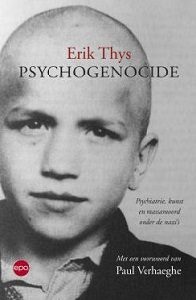
Author Erik Thys, psychiatrist and artist, gives his own name to what has remained underexposed until now: the mass murder of some 400,000 psychiatric patients in Germany, Poland and Austria.
By the Nazi regime, before and during World War II. He calls this the Psychogenocide.
Hitler, psychiatry and art
Thys argues that Hitler's failed artistry and his psychiatric past contributed to revenge actions on psychiatric patients. And, at the same time, on modern art. His first doctor called him ‘a psychopath with hysterical symptoms’.
Eugenics and Nazism
In a long but necessary prelude, the author describes the genesis of eugenics. This is the ideology that seeks to enhance the good (‘eu’) genetic material of a population. This ideology was first present in the Anglo-Saxon countries and in Scandinavia.
Precursor to this ideology was the pseudoscientific connotation of the - originally biological - concept of degeneration. This later partly steered the Nazi extermination machine. In addition, social Darwinism (survival of the fittest) largely determined eugenics.
History of eugenics
The originator of the term ‘eugenics’ was Briton Galton, nephew of Charles Darwin. The former wanted to financially support families with high eugenics scores as early as 1905. And he wanted ‘weaklings’ to be placed in homes with a ban on procreation.
In the US, selective sterilisation was started in 1910. American Journal of Psychiatry ran a polemic in 1942 about killing ‘congenitally defective’ without consent. It referred to the extermination of patients in Germany.
From sterilisation to destruction
In Germany, in 1903, the psychiatrist Rüdin (an associate of Kraepelin) advocated sterilising chronic alcoholics. This was a first beginning of the fight against the ‘degenerates’ (‘degenerates’) and the ‘inferiors’. This programme ended only after WWII.
From 1920, a stigmatisation and dehumanisation of the sick and disabled begins. This is when not only sterilisation but also ‘der vernichtung lebensunwerten Lebens’ becomes openly debated.
The role of psychiatrists, educators and the Church
Shortly after the 1933 coup, surgical sterilisation became compulsory. In people with chronic alcoholism, certain mental illnesses, mental problems, hereditary physical deformities, blindness and deafness, among others.
German psychiatrists, pedagogues and church leaders hardly reacted. The German people were a ‘people's body’ from which the ‘sick’ pieces had to be cut out.
Purebred art
Thys, himself an artist, describes in detail the same movement Nazi Germany made from eugenics towards artists. The concept of degeneration and social Darwinism also determined the Nazis‘ ’purge‘ of their arts.
The art world was divided into (kitschy, true-to-nature) ‘Deutsche’ art of healthy , purebreds on the one hand. And the ‘entartete’ art of moderns like Klee, Mondrian and Chagall on the other. In this perfidious strategy, modern artists were compared to (the demonised) psychiatric patients.
The medical and the language.
The plea for an ‘Aryan’ art was part of a general attempt by the Nazis to make the elimination, ‘endlösung’, of ‘minderwertigen’ digestible among the population. And so to arrive at a genetically ‘pure’ Aryan race.
One way this happened was by putting stigmatisation in a medical context. And by using disgusting language in film, media and education. For example, ‘empty human shells’, ‘ballast creatures’, ‘useless eaters’, ‘parasites’, etc.
Mass murder in psychiatry
The large-scale systematic killing of psychiatric patients was the first step in this. Psychiatric genocide began shortly after the invasion of Poland on 1 September 1939. That was when Hitler gave written authorisation to doctors for the ‘Gnadentod’ of ‘incurably ill’ patients.
First, 5,200 children with physical or mental disabilities were murdered. Then 200,00 Polish psychiatric patients were exterminated. This was followed by the gassing of 73,000 German psychiatric patients. Finally, 15-20,000 ‘useless’ prisoners were killed.
These massacres, coordinated from Berlin, were followed by the ‘wild’, decentralised killing of some 200,000 psychiatric patients until 1945. Through poisoning, neglect and starvation.
An exercise in genocide
Thys points out that the extermination of psychiatric patients was a sinister prelude to the Holocaust that followed. And this at two crucial points.
With the Psychogenocide, the expertise and organisation was developed, the personnel chosen that would then be used for the Final Solution. And secondly, the medical profession became the main actor in this process of mass destruction. This from the pseudoscientific eugenic paradigm and in the psychiatry.
Psychiatrists provided the expertise and ensured the concrete execution of the murder of psychiatric patients (concentrated in institutions). These medics later became heavily involved in the genocide behind the front and in the concentration camps.
The role of doctors
Even more shocking is the observation that the wild ‘euthanasia’ of psychiatric patients was done on the doctors' own initiative. Within their institutions. And faithfully following the systematics of centrally organised killings.
In doing so, Thys points to the special link that existed between medicine and Nazi ideology. And the link that existed between extermination and medicine. For example, medical tribunals were set up for sterilisation. The infamous racial laws were public health laws. Patients were sentenced to sterilisation or gassing based on medical diagnosis and selection by doctors.
German doctors constituted by far the proportionally largest professional group present in the Nazi organisation and in the SS. ‘’The mass murder had a medical aura across the board, with academics at the top and (...) doctors on the shop floor”' (p.229).
Importance of this book
This book is not just yet another confrontation with the most horrific period in human history.
Constant links to contemporary issues also emerge. Like, for instance, the government's use of language (‘illegal immigrants’). Or refugees as an economic burden. Biogenetics and euthanasia in psychiatric patients. The Vandereycken case we never knew about.
At the end of the book, Thys highlights some of these issues separately.
This is a chilling, truly mind-boggling but extremely important book. A book everyone should have read. Especially those who serve our vulnerable people.